Tuesday, March 15, 2011
Monday, March 7, 2011
Written assignment 3b - Place
Interpretation and evaluation – Since I wasn’t feeling very creative for the critique I put out 3 photos of the sunset. I am disappointed in myself for not printing a greater variety of the shots I took. The critique was helpful to enhance the idea of the pictures. Regarding the large sunset picture it was suggested that I add text to give it a different feel or provide more interest. The bus photo was well received but it was agreed that it would have been more effective if I made it larger, showing the reflection of the tree and lights. I had lightened the blue but when it was printed came out dark like the photo originally was shot. After printing it was dark once again. Comments were made to leave the blue as it provided a nice perspective to the picture.
Regarding the picture of Eastwood I decided to add in place of the other sunset because I am apparently not feeling so mellow today, and thought it would be more interesting to the viewer~
Written Assignment 3a - Place
This assignment was an interesting project because we were to photograph ‘place’. That can be interpreted in numerous ways. For this project I shot a number of pictures of the sunset in the countryside. This time of day has always been my favorite and the softness of the light and beauty of the landscape is one of my favorite pictures to shoot. It brings me an inner peace and as I explained to class a sense of freedom since I lived with someone who didn’t care for my sunset photos! By changing one of the photos to black and white it gives a different perspective of what we normally see at that time of day and it appears surreal without the color. Place to me in the sunset photo is tranquility. Another set of shots I took was at Eastwood Shopping Center after it had closed and on a night where most people were home in front of a roaring fire instead of driving around taking pictures. Without people in the shot it gives the picture a lonely feel while at the same time illustrating beauty of the quietness. It was a perspective that isn’t usually seen in that area. I appreciated the carnival feeling with the string of lights that flowed with the lamp posts going in an opposite direction. The picture of the bus shows an everyday item with a different view. The reflection of the lights and tree bouncing off the bus makes it look as if it is a whole picture rather than a reflection. The blue lighting softens the idea of the hard metal vehicle.
Historical Photographer - Lee Miller
http://www.leemiller.co.uk/images/self.jpg
http://www.leemiller.co.uk/images/photos/large/114.jpg 1937 - Eileen Agar’s shadow on the Royal Pavilion Brighton, England (Portrait series)
http://www.leemiller.co.uk/images/photos/large/1058.jpg 1937 - Pablo Picasso, Hotel vaste Horizon, Mougins, France (Portrait series)
http://www.leemiller.co.uk/images/photos/large/76.jpg 1933 – Scent Bottles, New York, NY (New York series)
http://www.leemiller.co.uk/images/photos/large/48.jpg 1930 – Charlie Chaplin, Paris, France (Paris series)
Lee Miller was born in 1907 in Poughkeepsie, New York USA and began her career as a model for famous photographers of the day such as Edward Steichen, Hoyningen-Huene and Arnold Genthe.
In March, 1929 she was the first ‘real’ person to pose for Kotex pads. The same year she also went to Paris and opened her own studio working with well-known photographer Man Ray. Her work became known as a portraitist and fashion photographer but the work she is best known for is the surreal photos in the Liberation of Paris, Hitler’s house burning the night the Germans surrender, Pablo Picasso and those taken during World War II. Her photos were intense, descriptive and often times disturbing.
She returned to New York in 1932 and opened another studio and ran that for 2 years before marrying Aziz Eloui Bey, an Egyptian businessman. At that time she went to Cairo Egypt and became interested in the deserts and villages of the area so began taking pictures of those areas. She traveled to Paris in 1937 and met her second husband, Roland Penrose, a Surrealist artist. They traveled to Romania and Greece and then went to London in 1939 as a freelance photographer for Vogue just prior to World War II breaking out.
She was the only female photo-journalist to cover the war in Europe. In 1944 she became a correspondent for the US Army and along with David E. Scherman, (a Time Life photographer), and together they ‘followed the US troops on D-Day + 20’. During this time she witnessed many world events including; “the siege of St Malo, the Liberation of Paris, the fighting in Luxembourg and Alsace, the Russian/American link up at Torgau, the liberation of Buchenwald and Dachau”, as well as photos of peasants in post war Hungary, dying children in Vienna and the execution of a prime minister.
She worked for 2 years after the war for Vogue photographing fashion and models. Her portraits of Picasso and other famous artists are believed to be some of the most powerful photos ever taken of the artists. She is remembered mostly for her “witty Surrealist images which permeate all her work”. Lee Miller died at Farley Farm House in 1977.
http://www.leemiller.co.uk/images/photos/large/114.jpg 1937 - Eileen Agar’s shadow on the Royal Pavilion Brighton, England (Portrait series)
http://www.leemiller.co.uk/images/photos/large/1058.jpg 1937 - Pablo Picasso, Hotel vaste Horizon, Mougins, France (Portrait series)
http://www.leemiller.co.uk/images/photos/large/76.jpg 1933 – Scent Bottles, New York, NY (New York series)
http://www.leemiller.co.uk/images/photos/large/48.jpg 1930 – Charlie Chaplin, Paris, France (Paris series)
Lee Miller was born in 1907 in Poughkeepsie, New York USA and began her career as a model for famous photographers of the day such as Edward Steichen, Hoyningen-Huene and Arnold Genthe.
In March, 1929 she was the first ‘real’ person to pose for Kotex pads. The same year she also went to Paris and opened her own studio working with well-known photographer Man Ray. Her work became known as a portraitist and fashion photographer but the work she is best known for is the surreal photos in the Liberation of Paris, Hitler’s house burning the night the Germans surrender, Pablo Picasso and those taken during World War II. Her photos were intense, descriptive and often times disturbing.
She returned to New York in 1932 and opened another studio and ran that for 2 years before marrying Aziz Eloui Bey, an Egyptian businessman. At that time she went to Cairo Egypt and became interested in the deserts and villages of the area so began taking pictures of those areas. She traveled to Paris in 1937 and met her second husband, Roland Penrose, a Surrealist artist. They traveled to Romania and Greece and then went to London in 1939 as a freelance photographer for Vogue just prior to World War II breaking out.
She was the only female photo-journalist to cover the war in Europe. In 1944 she became a correspondent for the US Army and along with David E. Scherman, (a Time Life photographer), and together they ‘followed the US troops on D-Day + 20’. During this time she witnessed many world events including; “the siege of St Malo, the Liberation of Paris, the fighting in Luxembourg and Alsace, the Russian/American link up at Torgau, the liberation of Buchenwald and Dachau”, as well as photos of peasants in post war Hungary, dying children in Vienna and the execution of a prime minister.
She worked for 2 years after the war for Vogue photographing fashion and models. Her portraits of Picasso and other famous artists are believed to be some of the most powerful photos ever taken of the artists. She is remembered mostly for her “witty Surrealist images which permeate all her work”. Lee Miller died at Farley Farm House in 1977.
Recreation Assignment R04 - Popular Media Semi-Contemporary Photographer
David Levinthal – Semi-contemporary photographer
http://www.slate.com/id/3469/
David Levinthal was born in San Francisco, California in 1949. I was drawn to his work because of the lighting he used as well as the creative way in which he used toys to create the photographs. Additionally, I was inspired by Tori’s rendition of the ‘cows’ and from her pictures realized there is another way to look at photography other than just sunsets and portraits.
He obtained a degree in Management Science from the Massachusetts Institute of Technology in 1981, an MFA in Photography from Yale University in 1973 a Bachelor’s of Art from Stanford University in 1970. He was also awarded a John Simon Guggenheim Foundation Fellowship in 1995 and a National Endowment for the Arts Fellowship in 1990-1991.[1]His photographs were created utilizing mostly large-format Polaroid photography. He created the pictures using aspects of American culture, Barbie, hockey, baseball, the Wild West and X-rated figurines. He has an excellent talent for creating the environment for the toys to make them appear to be real people, making the photo surreal yet realistic.
He uses shoeboxes, cardboard, and foam core to create the tiny offices, hotel rooms, war zones and old west to create an intimacy in small spaces, exploring different emotions and creating voyeuristic aspects to his work. His biography indicates that his work is inspired by his experiences as a child and pop culture of that time.
Levinthal indicates that "Toys are intriguing, and I want to see what I can do with them. On a deeper level, they represent one way that society socializes its young." Furthermore, Levinthal is aware of the power of toys: “Ever since I began working with toys, I have been intrigued with the idea that these seemingly benign objects could take on such incredible power and personality simply by the way they were photographed. I began to realize that by carefully selecting the depth of field and making it narrow, I could create a sense of movement and reality that was in fact not there.”
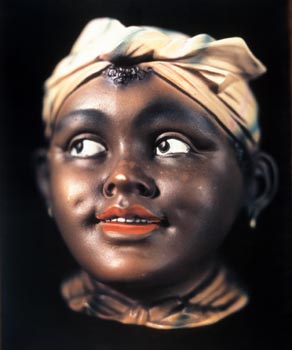
His creation of Blackface caused such a reaction and controversy at the Institute of Contemporary Art in Philadelphia that the exhibition was canceled before it had an opportunity to open.
The Passion – 2005 Blackface -1995-98
Mein Kampf 1993-94 Barbie - 1998-99
Sunday, March 6, 2011
BW Photo MSU STA491: Popular Media Photographer Presentations (Semi-Con...
BW Photo MSU STA491: Popular Media Photographer Presentations (Semi-Con...: "Pick one photographer from the “Semi-Contemporary Photographers” list on the Recreation 04 handout. Add a comment to this blog entry with th..."
Subscribe to:
Posts (Atom)